Selecting the right kitchen countertop is one of the most consequential decisions in any home renovation. Beyond serving as a visual centerpiece, your countertops take the brunt of daily domestic life: chopping vegetables, enduring hot pots, absorbing spilled red wine, and hosting family gatherings. For years, the debate over high-end kitchen surfaces has centered on two undeniable heavyweights: quartz and granite.
While both surfaces deliver exceptional durability and long-term home value, they are fundamentally different materials. Granite is an authentic natural stone pulled directly from mountain quarries, whereas quartz is an engineered composite designed to overcome some of nature’s inherent vulnerabilities. Choosing the ideal material for your kitchen requires looking past showroom displays and evaluating how each surface stands up to moisture, heat, daily maintenance, and long-term use.
Understanding the Material Origins
Understanding how each countertop is manufactured provides immediate insight into how it performs on top of your cabinetry.
-
Granite is one hundred percent natural stone: Formed deep beneath the Earth’s crust over millions of years through cooling magma, granite is a dense mixture of quartz, feldspar, mica, and other minerals. Large blocks are chiseled out of quarries in places like Brazil, India, and North America, sliced into dimensional slabs, and polished to reveal unique geological patterns. No two slabs of natural granite are ever identical.
-
Quartz is an engineered composite surface: Often referred to as engineered stone, quartz countertops consist of roughly ninety to ninety-three percent crushed natural quartz crystals, combined with seven to ten percent polymer resins, binding agents, and color pigments. This blend is subjected to immense pressure, heat, and vibration inside industrial vacuum presses, producing a completely non-porous solid slab with uniform structural integrity.
Because granite is a direct product of nature, it retains unpredictable natural fissures, mineral pockets, and structural variations, while quartz offers calculated consistency from end to end.
Appearance, Pattern Consistency, and Visual Appeal
Your visual preference will play an enormous role in determining which surface belongs in your space.
-
The organic drama of granite: Natural granite offers unmatched visual depth and authentic movement. You will see iridescent flecks of mica, swirling ribbons of color, and subtle crystalline structures that shift as ambient sunlight moves across the room. However, because each slab is unique, matching patterns across adjacent seams can be challenging. You must visit the stone fabrication yard in person to tag the exact slab you want installed.
-
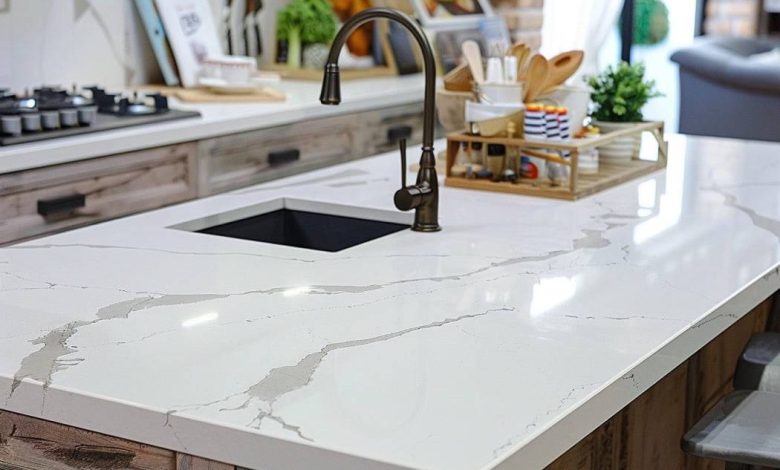
The uniform control of quartz: Quartz manufacturers have advanced their engineering significantly, producing slabs that convincingly replicate everything from classic Italian Carrara marble to raw industrial concrete. Because quartz patterns are computer-guided, you get predictable veining and identical coloration across multiple slabs. This makes hiding seams in sprawling L-shaped or U-shaped layouts far easier than with natural stone.
-
Modern finish options: Both materials were historically sold with high-gloss polished finishes, but current design trends lean heavily toward tactile surfaces. Granite and quartz are both readily available in honed (matte, flat sheen) and leathered (subtly textured, soft pebble feel) finishes, which diffuse light and help conceal daily fingerprints.
If you appreciate the irregular, one-of-a-kind imperfections of raw geology, granite is hard to top. If you prefer controlled, cohesive palettes with predictable patterns, quartz is the clear winner.
Porosity, Stain Resistance, and Sealing Demands
How a surface interacts with moisture, liquids, and bacteria dictates how much effort you will spend keeping it sanitary and clean.
-
Granite is porous and requires regular sealing: Natural stone possesses microscopic pores and capillary channels. If left unsealed, liquids like citrus juice, cooking oil, red wine, and vinegar will seep deep into the stone, causing dark stains and harboring bacteria. To prevent this, granite must be treated with a penetrating impregnator sealer upon installation and resealed periodically throughout its lifespan.
-
Quartz is completely non-porous: Thanks to the dense polymer resin matrix, quartz contains zero microscopic pores. Liquids, grease, and acidic spills sit directly on top of the surface without penetrating. Quartz never requires sealing, conditioning, or waxing, ever.
-
Hygiene and antimicrobial performance: Because quartz does not absorb liquids, bacteria, viruses, and mold have no internal voids to colonize. For busy family kitchens where raw poultry and sticky spills are frequent occurrences, quartz provides a naturally hygienic, zero-maintenance work surface.
Granite remains stain-resistant when properly sealed, but quartz is inherently stain-proof without any protective chemical applications.
Heat Resistance and Thermal Shock Vulnerability
Kitchen countertops routinely come into contact with boiling cookware, baking sheets, and slow cookers, making heat tolerance a critical comparison point.
-
Granite handles direct high heat effortlessly: Because granite formed under extreme volcanic temperatures, it boasts extraordinary thermal resistance. Setting a sizzling cast-iron skillet, hot roasting pan, or fresh-from-the-oven Dutch oven directly onto a granite countertop will not melt, scorch, or discolor the stone.
-
Quartz is susceptible to heat damage: While the natural quartz mineral inside the slab is heat-resistant, the polymer resins binding the slab together are not. Exposing a quartz countertop to temperatures exceeding 300 degrees Fahrenheit can cause the resin binders to burn, turn yellow, or crack from sudden thermal shock.
-
Protecting your counters: When working with quartz, you must form the habit of always using silicone trivets, hot pads, or wooden boards underneath boiling pots, slow cookers, and air fryers. Granite is far more forgiving of accidental contact with hot cookware.
If you are an active home chef who prefers placing hot pans directly down without searching for a trivet, granite provides absolute peace of mind.
Everyday Durability, Scratching, and Chip Repairs
Both materials are exceptionally hard, ranking between six and seven on the Mohs Hardness Scale, but their practical everyday durability differs slightly.
-
Resistance to scratching: You can chop vegetables directly on both granite and quartz without dulling or scratching the stone (though doing so will quickly ruin your kitchen knife blades). Quartz has a slight edge in scratch resistance over lighter, softer varieties of granite that contain higher concentrations of soft feldspar or calcite.
-
Chipping along perimeter edges: The most common damage to kitchen counters occurs when heavy pots or glass dishware strike exposed edges, particularly around under-mount sink cutouts. Granite can chip along sharp 90-degree edges, though fabricators can easily patch these divots using color-matched epoxy adhesives.
-
Flexural strength: Because quartz contains flexible polymer resins, it has superior flexural strength compared to granite. It is less brittle, meaning it can tolerate longer cantilevered overhangs on islands with less risk of cracking during transport or heavy daily use.
Selecting an eased, pencil, or bullnose edge profile on either stone rounds the sharp corners, drastically reducing the likelihood of accidental chipping.
Environmental and Indoor Air Considerations
Homeowners increasingly weigh the ecological footprint of their building supplies when planning a kitchen overhaul.
-
Granite harvesting and quarrying: Granite is an abundant, naturally occurring geological resource, requiring no industrial chemicals to synthesize. However, the quarrying process requires heavy mechanical extraction, and transporting heavy stone slabs across global shipping routes consumes substantial fossil fuels.
-
Quartz production and resin chemistry: Quartz makes efficient use of recycled stone aggregate and mining byproducts that might otherwise go to waste. However, the manufacturing process relies on petroleum-derived synthetic resins, curing ovens, and water-intensive industrial machinery.
-
Indoor emissions: High-quality quartz products carry third-party certifications like Greenguard, verifying low volatile organic compound emissions. Pure natural granite produces zero synthetic chemical off-gassing, although certain geological slabs can emit trace, negligible levels of naturally occurring radon gas, which rarely poses a residential health risk.
Both materials are non-toxic, chemically inert in standard residential conditions, and durable enough to avoid ending up in landfills for generations.
Installation Complexity and Real-World Costs
When budgeting for your project, both materials fall into a similar broad pricing tier, but specific slab choices create notable cost fluctuations.
-
Raw material price points: Entry-level granite (often labeled Level 1 or commercial grade) is frequently cheaper than baseline quartz. However, rare exotic granites with dramatic veining can easily outprice high-end designer quartz slabs.
-
Fabrication and professional installation: Neither material is suitable for amateur do-it-yourself installation. A standard eight-foot slab easily weighs over two hundred pounds, requiring specialized transport clamps, laser-leveling equipment, bridge saws, and diamond-blade polishing wheels.
-
Long-term value return: Both quartz and granite deliver strong real estate appeal. Potential homebuyers recognize both names as premium upgrades, routinely recovering sixty to eighty percent of their installation cost in home equity appraisals.
Investing in an experienced, reputable stone fabricator is far more critical than deciding between the two stones, as poor seam placement or uneven leveling will ruin the appearance of either surface.
Frequently Asked Questions
Can quartz countertops be safely installed on outdoor kitchen islands?
Quartz is not recommended for outdoor kitchens or patios exposed to direct sun. The polymer resins that bind the quartz particles together are vulnerable to ultraviolet degradation. Chronic sun exposure causes the resin to break down, resulting in noticeable yellowing, fading, and surface chalking over time. For outdoor spaces, sealed granite, soapstone, or porcelain slabs are far superior choices.
How do I test whether my granite countertop needs to be resealed?
You can run a simple water drop test. Splash a few tablespoons of tap water directly onto the granite surface and let it sit undisturbed for fifteen minutes. If the water remains in beads on top of the stone, your seal is intact. If the water has soaked into the stone and left a visible dark ring beneath the droplet, the protective sealant has worn away and needs reapplication.
What everyday household cleaners should be avoided on quartz and granite?
Never use acidic, abrasive, or highly alkaline cleaners on either material. Avoid bleach, ammonia, white vinegar, lemon juice, oven cleaner, and abrasive scrubbing powders. These chemicals can strip the sealant off natural granite and chemically degrade the resin binder on quartz, leaving permanent dull spots known as etching. Stick to warm water, mild dish soap, and a soft microfiber cloth.
Is it possible to permanently repair a burn mark on a quartz countertop?
Repairing a severe heat burn on quartz is extremely difficult because the resin within the material has chemically scorched. While a trained stone restoration technician can sometimes buff out minor, shallow surface singes, deep discoloration often penetrates through the slab thickness. In severe cases, the damaged section must be precision-cut out and patched with a matching remnant, or the entire slab must be replaced.
Why do some granite slabs cost three times more than others?
Granite pricing is dictated almost entirely by rarity, quarry accessibility, and shipping logistics rather than structural strength. Common granites featuring uniform, speckled patterns quarried in massive volumes are affordable (Level 1). Slabs displaying rare colorations like vibrant blue, exotic veining, or those extracted from remote quarries in limited quantities are classified as exotic (Level 3 or higher) and carry steep price premiums.
Can dropping a heavy cast-iron pan crack an entire quartz or granite slab?
While both materials are remarkably durable, a severe, concentrated impact from a heavy cast-iron skillet can crack or shatter either stone, particularly near cutouts for sinks and cooktops where the slab is narrowest. Granite is more brittle and prone to structural cracking along hidden natural fissures, whereas quartz is slightly more elastic but will chip or fracture along edges under direct impact.
Do quartz countertops look completely artificial compared to genuine stone?
Early generations of quartz often had an artificial, pixelated look with unnatural speckled patterns. Modern manufacturing techniques utilize multi-layered pigment injection and advanced veining algorithms, producing designs that mirror the depth, movement, and subtle color variations of natural marble and granite. At a casual glance, modern high-end quartz is frequently mistaken for natural quarried stone.