
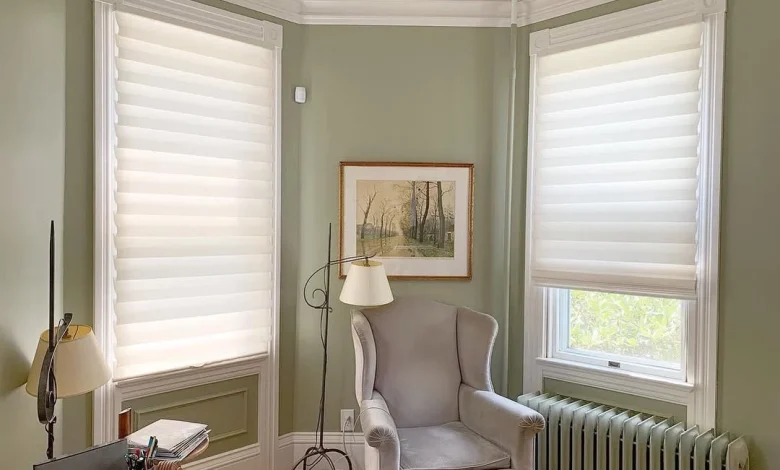
Roman shades have a particular ability to make a window feel finished without adding the visual weight of full-length drapery. Their tailored silhouette works beautifully across a wide range of interiors, from pared-back contemporary rooms to richly layered traditional spaces. But once you have decided on the style, there is another design question to answer: should your roman shade be patterned or plain?
Neither is inherently better. The right choice depends on the role you want the window to play within the room.
A plain roman shade can provide a moment of calm, allowing wallpaper, artwork, furniture, or architectural details to take the lead. A patterned shade, on the other hand, can turn an otherwise overlooked window into a considered focal point. The decision comes down to visual balance, scale, color, texture, and, perhaps most importantly, how much personality you want the window to bring to the room.
Start With the Room, Not the Window
It is tempting to choose a shade simply because you love the fabric. But the better starting point is the room itself.
Look at the walls, upholstery, rug, artwork, flooring, and other textiles. Is the space already full of patterns? Are the walls quiet and neutral? Does the room have an architectural feature that deserves attention, or does it need something to give it more character?
A window treatment should contribute to the overall composition rather than compete with it.
If the room already has several strong patterns, a plain shade can provide valuable breathing room. If everything is neutral and restrained, a patterned shade may be exactly what the room needs to feel more layered.
When Plain Roman Shades Work Best
Plain shades are often the most elegant choice when the room already has plenty happening elsewhere.
A beautifully textured solid fabric can add depth without introducing another visual motif. Linen, cotton, velvet, and woven fabrics can all give a plain shade considerable character through their surface and drape.
This approach works particularly well in rooms with patterned wallpaper, statement rugs, decorative upholstery, or large-scale artwork. The shade quietly supports those elements rather than asking for attention of its own.
But plain does not have to mean predictable.
A warm ivory linen can soften a contemporary white room. A charcoal fabric can give a monochromatic interior more definition. A muted sage or dusty blue can pick up a color already used elsewhere without introducing a new pattern.
When Patterned Roman Shades Make Sense
A patterned roman shade can be transformative when the rest of the room is relatively quiet.
Perhaps the walls are painted in a soft neutral and the furniture is intentionally understated. Perhaps the window itself feels like a blank space that needs more personality. In either situation, pattern can give the room a focal point without requiring additional artwork or accessories.
Florals, stripes, checks, geometrics, botanicals, and abstract motifs can all work beautifully.
The key is choosing a pattern that relates to the room’s existing style. A delicate floral can enhance a traditional bedroom, while a restrained geometric may feel more natural in a contemporary space.
Think About Scale
Pattern scale is one of the most important considerations when choosing a roman shade.
A large-scale motif can look spectacular on a wide window, where there is enough surface area for the design to be appreciated. On a narrow window, however, the same pattern may become awkwardly cropped or visually overwhelming.
Small-scale patterns tend to be more forgiving, particularly on smaller windows. They create visual interest without making the treatment feel disproportionately busy.
If you are considering a bold pattern, always look at a reasonably large fabric sample. A small swatch can make a dramatic print seem much quieter than it will appear across an entire shade.
Consider Pattern Placement
With roman shades, pattern placement matters more than it does with some other window treatments because the fabric folds and stacks as the shade is raised.
A beautiful large-scale motif can lose its impact if the most important part of the design disappears into the folds. Conversely, thoughtful placement can make a shade feel almost like a piece of framed textile art.
This is one area where custom roman shades offer a significant advantage. The fabric can be cut and positioned specifically for the dimensions of the window, allowing the pattern to be presented intentionally rather than simply fitted to a standard size.
If you are investing in a distinctive fabric, this level of control can make a considerable difference.
Use Color to Create Cohesion
Patterned shades do not need to introduce an entirely new color palette.
In fact, the most successful treatments often pick up a color that is already present in the room. A blue-and-white patterned shade might echo blue upholstery. A botanical print could repeat the green of a rug or artwork. A warm neutral pattern can connect to wood tones and natural materials.
This creates a sense of continuity without requiring an exact match.
With plain shades, the same principle applies. Look for a color that either blends into the surrounding palette or provides a deliberate but controlled contrast.
The best color is not necessarily the one you like most in isolation. It is the one that makes the rest of the room look better.
Don’t Forget Texture
If you are unsure whether the room can handle another pattern, texture can offer a middle ground.
A plain linen roman shade, for example, may look understated from across the room but reveal plenty of visual interest up close. The irregular weave catches light and creates subtle variation across the surface.
This is especially effective in neutral interiors where pattern may feel unnecessary. A textured shade can add depth while preserving the calm atmosphere.
Velvet, woven cotton, slubby linen, and other tactile fabrics can similarly give plain shades a more luxurious presence.
Match the Treatment to the Architecture
The style of the room should influence whether you choose a patterned or plain shade.
In a minimalist interior, a simple solid shade may reinforce the clean architectural lines. In a traditional room with molding, decorative furniture, and layered textiles, a patterned roman shade may feel completely at home.
But contrast can be equally effective.
A traditional floral shade in an otherwise contemporary room can create a sophisticated tension, while a simple linen shade can make a heavily traditional interior feel fresher and less formal.
The objective is not necessarily to match the architecture. It is to make the choice feel intentional within it.
Consider the Size and Number of Windows
One patterned roman shade may be charming. Six patterned shades covering an entire wall can have an entirely different effect.
If a room has several windows, think about the combined visual impact. Repeating a bold pattern across multiple windows can make it a major feature of the space.
This can be spectacular when intentional, particularly in dining rooms, bedrooms, and studies. But if the room already has a patterned wallpaper or heavily decorated furnishings, repeating the motif across several shades may be too much.
In larger window groupings, a quiet textured fabric can often provide a more balanced solution.
What About Neutral Interiors?
Neutral rooms are particularly well suited to both approaches.
A plain roman shade can maintain the quiet sophistication of a neutral palette, especially when the fabric has an interesting weave. For instance, plain gray window roman shades in a slubby linen texture will instantly warm up your space. A patterned shade can introduce a controlled dose of personality without disrupting the overall calm.
For a subtle effect, choose a pattern with a low contrast between its colors. A tonal stripe, faded botanical, or understated geometric can provide detail without becoming the focal point.
If the rest of the room is extremely minimal, however, you can be more adventurous with scale and contrast.
Think About Privacy and Light Control
Design should not be the only consideration.
Before choosing your fabric, think about how the window functions. Is it in a bedroom where privacy is essential? Does it receive intense afternoon sun? Is the view something you want to preserve?
A decorative fabric may need an appropriate lining to provide the necessary light control and privacy.
For bedrooms, blackout lining can be particularly useful. In living areas, a light-filtering option may be preferable if you want to maintain a bright atmosphere.
The decorative decision and functional decision should work together.
Patterned or Plain? Let the Room Decide
If you are still torn between the two, ask yourself a simple question:
Does the room need another visual element, or does it need a moment of quiet?
If the room already has patterned wallpaper, colorful upholstery, or a statement rug, a plain textured roman shade will probably create a more balanced result.
If the walls, furniture, and accessories are relatively restrained, a patterned shade can provide the character and visual interest the room is missing.
And if you want something between the two, choose a tonal pattern or textured solid. It can give you the depth of a print without the same visual impact.
The Best Choice Is the One That Completes the Room
Choosing between patterned and plain roman shades is ultimately less about following a design rule and more about understanding balance.
A patterned shade can bring personality, color, and movement to an understated room. A plain shade can provide calm and sophistication when the rest of the interior already makes a statement. Both can be equally luxurious when the fabric, proportions, construction, and color are right.
So before choosing a fabric, step back and look at the room as a whole. Consider what the walls are doing, where your eye naturally lands, how much pattern is already present, and what the windows need to contribute.
The perfect roman shade is not necessarily the one that makes the biggest statement.
It is the one that makes the room feel more considered.


